
Understand how your brand is discovered, compared, and acted on in China.
Use GEO Workspace to test how your organisation appears across major Chinese AI engines, or China Traveller GEO Concierge to examine the wider traveller decision journey across AI, social search, travel platforms, maps and action paths.
Self-service Chinese AI assessment or specialist managed traveller GEO.
GEO FOR CHINA
Two ways to understand how your organisation appears in China
Choose self-service Chinese AI assessment for repeatable testing, or a specialist managed audit when the decision journey extends across traveller platforms, social search, maps and action paths.
SELF-SERVICE
GEO Workspace
China Audience GEO across major Chinese AI engines
Build structured Simplified-Chinese assessments, compare evidence across configured AI engines and identify where your organisation is visible, substituted, weakly supported or difficult to act on.
- 20-question standard assessment
- 6-engine China AI testing
- Model Only + Search Enhanced
- Evidence-linked results and reports
What’s Changing in China’s Discovery and Conversion Journey
China’s major platforms are no longer just channels for reach. They are increasingly shaping what gets seen, what gets trusted, and what gets chosen.
Shift 02
Trust is increasingly formed in-platform
Evaluation now happens inside community, creator, search, and native platform environments before users ever reach an owned destination.
Shift 03
Conversion is moving closer to content
Content, commerce, inquiry, booking, and service touchpoints are becoming more connected, reducing the distance between interest and action.
PRODUCT IN PRACTICE
From Chinese decision questions to evidence you can inspect
GEO Workspace keeps the tested question, provider response, returned sources and assessment context connected. Traveller GEO extends that evidence discipline into the wider traveller decision system.
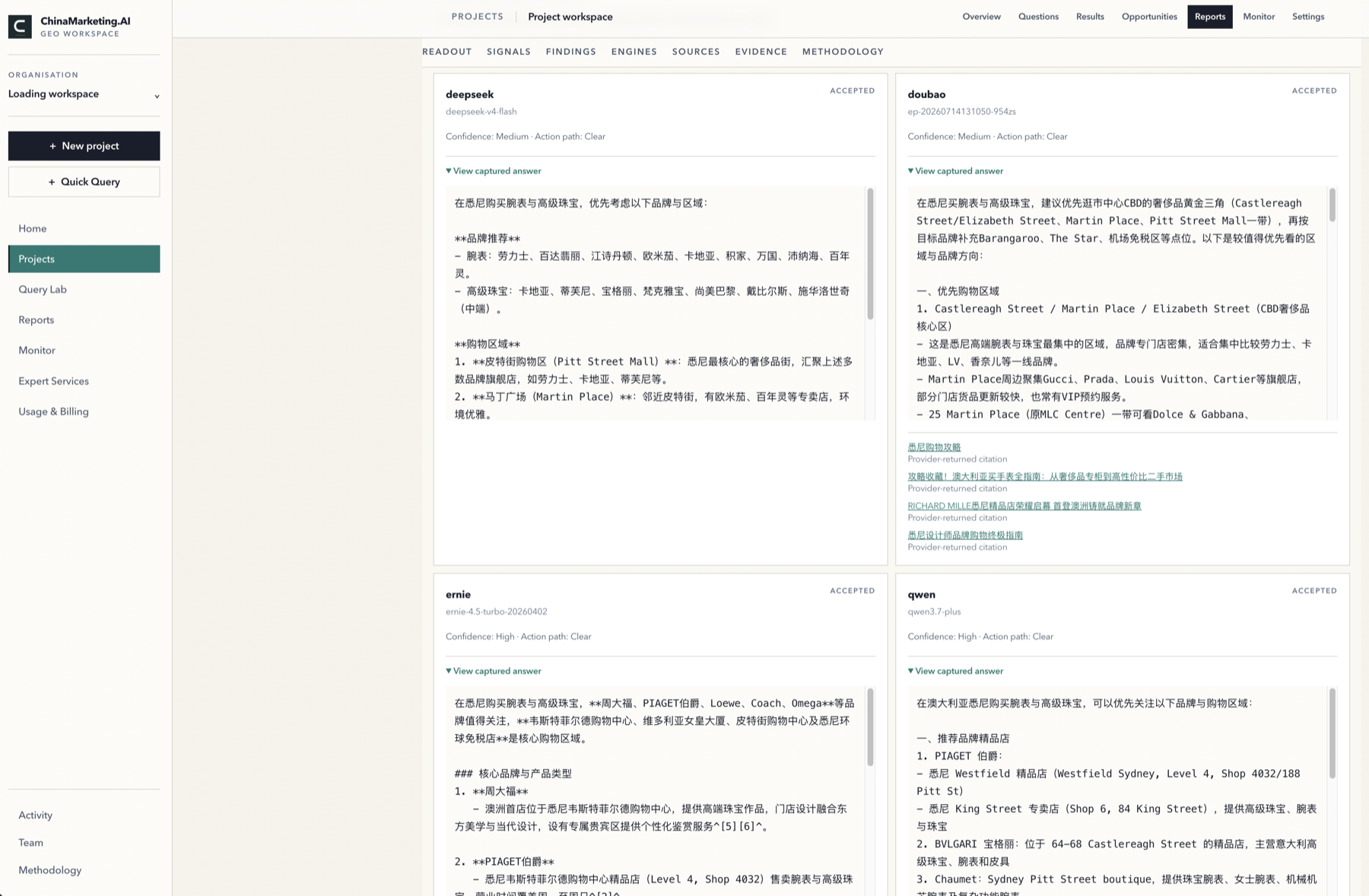
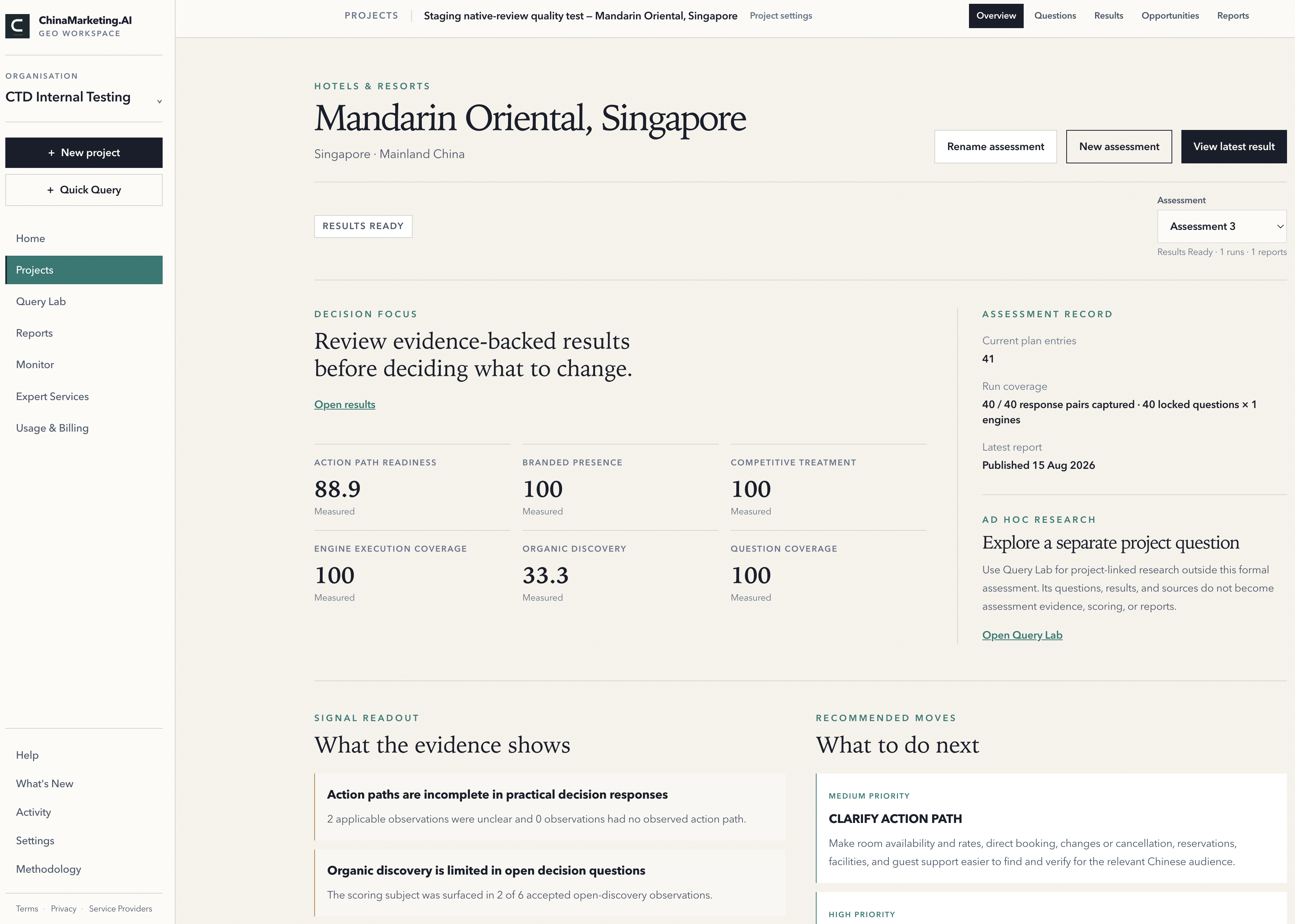
Need evidence beyond AI? Traveller GEO extends the assessment across Chinese social search, travel platforms, maps and owned or partner action paths. Explore China Traveller GEO Concierge.
Broader China visibility, conversion and activation support
GEO is one part of the China decision journey. CTD also helps teams diagnose social visibility, remove conversion friction and build more consistent China execution.
China Social Visibility
Diagnose where brand presence appears, disappears, or underperforms across China’s key discovery touchpoints.
China Conversion Spine
Build the pathways that turn discovery into inquiry, booking, purchase, or next-step action.
China Activation Blueprint
Give teams the tools, workflows, and rollout structure needed to execute more consistently across markets or locations.
How China journeys are shifting
Discovery, trust, and action are increasingly happening inside the platform journey
China user journeys no longer separate media, trust-building, and action into clean stages. China Marketing AI helps teams see where discoverability is weak, where reassurance forms, and where next-step action starts to stall.
- Visibility now depends on more than owned channels.
- Source quality affects how confidently brands are represented.
- Action paths matter alongside discovery.
- Teams need a connected view across platforms.
Experience across hospitality, travel, destinations, retail, mobility, finance, and global brand work.












































































Selected Work
Examples of how CTD turns China visibility, audience and conversion questions into audits, research, platforms and operating programmes.
FAQ
Answers to common questions about the product, approach, and how it supports China-facing decisions.
What is China Marketing AI?
China Marketing AI is CTD’s China intelligence and GEO product environment for understanding how brands, destinations and organisations are discovered, evaluated and acted on across China-facing digital journeys. It combines self-service GEO tools, specialist China traveller diagnostics and broader visibility, conversion and activation services.
What is GEO Workspace?
GEO Workspace is the self-service China Audience GEO platform from ChinaMarketing.AI. It lets teams run structured Simplified-Chinese questions across configured Chinese AI engines, preserve the evidence behind each response and turn the results into repeatable assessments and reports.
What is China Traveller GEO Concierge?
China Traveller GEO Concierge is CTD’s managed specialist service for understanding how Mainland Chinese outbound travellers encounter an organisation across AI, Chinese social search, travel platforms, maps and owned or partner action paths. It extends beyond AI visibility into competitor substitution, source gaps, factual risk and traveller-action readiness.
Which should I use: GEO Workspace or China Traveller GEO?
Use GEO Workspace when you want repeatable self-service testing across Chinese AI engines. Use China Traveller GEO when the commercial question is specifically about Chinese travellers and requires broader evidence across AI, social search, travel platforms, maps and conversion paths with analyst review.
Does GEO Workspace guarantee AI rankings or recommendations?
No. GEO Workspace measures observed answers under defined questions, engines and execution conditions. It does not control external AI systems, guarantee recommendations or prove sales attribution.
What is the Free AI Visibility Snapshot?
The Free AI Visibility Snapshot is a directional China Traveller GEO entry point. It provides an initial view of blind discovery and branded readiness before a deeper managed Traveller GEO audit is considered.
Does ChinaMarketing.AI only cover AI?
No. GEO Workspace focuses on structured Chinese AI assessment and research, while China Traveller GEO can extend into Chinese social search, travel platforms, maps and owned or partner action paths. CTD also provides broader China social visibility, conversion and activation support.
How is it related to China Trading Desk?
China Marketing AI is built by China Trading Desk and draws on CTD’s China platform knowledge, research, traveller intelligence and delivery experience.
Latest Intelligence
This issue tracks three platform-level shifts with direct implications for brand discovery, conversion, and campaign planning in China. Xiaohongshu is formalizing taste-driven product selection via its REDone program and offline retail, while also institutionalizing 'product seeding' as a certified profession. WeChat is consolidating October rule updates, service-provider incentives, and 11.11 campaign mechanics inside its Store Growth Center, signaling a more structured affiliate and livestream commerce playbook. Douyin's Double 11 opening emphasizes shorter cycles, simplified mechanics, and platform-funded coupons, with smaller merchants and creators as growth drivers. For international brands in travel, hospitality, retail, and destination marketing, the common thread is that platform-native content and commerce integration is becoming more standardized, measurable, and operationally demanding.
Updated: 27/10/2026, 8:08:14 am GMT+8
View Full BriefXiaohongshu Launches REDone Taste Program and Double 11 Hub, Extending Curation to Offline Retail
Xiaohongshu introduced the REDone annual good-taste program and a Double 11 main venue, selecting products across aesthetics, craftsmanship, originality, quality, and uniqueness. A Shanghai offline 'Xiaohongshu Specialty Store' connects online seeding to physical retail.
网经社
行业媒体
WeChat Store Growth Center Consolidates October Rules, Affiliate Incentives, and 11.11 Campaign Tools
The WeChat Store Growth Center page lists October new rules, service-provider incentives, affiliate seller incentive programs, 11.11 platform campaign activities, and a call for feedback on AI digital-human livestream content management standards.
微信小店
官方平台
Douyin Double 11 Opens with Shorter Cycle, Simplified Mechanics, and Platform-Funded Coupons
Douyin e-commerce reported Double 11 opening data, highlighting a shorter campaign period, simplified gameplay, platform-funded consumer coupons, and growth from small and new merchants and creators. Seasonal change drove category growth.
光明网
编辑媒体
See how your organisation appears in China’s decision journey
Start with GEO Workspace for self-service Chinese AI assessment, or talk to us about a specialist China Traveller GEO audit.